
Key takeaways
- This article covers three core channels for community business exposure: local directory listings, neighborhood sponsorships, and hyperlocal content, plus community partnerships and KPI tracking to support each one.
- Many of these tactics can be tested for under $200; plan a modest $200, $500 budget for sponsorships and other in-person formats.
- NJLocalInfo.com is the featured platform for New Jersey businesses seeking town-level visibility that national directories don’t offer.
- Each tactic includes a practical way to measure results so you know what’s working before you invest more time or money.
- The goal: leave this article with a clear action plan you can start this week.
Many small business owners spend real money on digital ads that reach people in different states, different counties, or just different parts of their own city, people who will never become customers. The actual opportunity is much closer: community business exposure, the kind of visibility that puts your name in front of people two miles away who are already searching for what you sell. That’s a fundamentally different game, and it’s one you can compete in without a massive budget.
This article covers three channels that build genuine local visibility: directory listings, neighborhood sponsorships, and hyperlocal content. Along the way, you’ll also find practical guidance on community partnerships and tracking results. For each channel, you’ll get specific tactics, a simple way to measure performance, and a realistic cost estimate. Platforms like NJLocalInfo.com exist precisely because town-level exposure requires a different tool than a national directory. By the end, you’ll have a clear plan you can start this week.
Why broad advertising misses and community exposure wins
The local discovery data that changes the math
According to SOCi’s 2026 research, 59 to 61 percent of local customer journeys start with search and maps, and 52 percent of consumers used AI tools to research a local business within a single 30-day period. Customers are actively looking for businesses like yours right now, from nearby. You don’t need a massive ad budget to reach them, you need to show up in the right places when they search.
The math shifts when you focus on local search rather than broad reach. A customer searching for a plumber in a specific town isn’t browsing options nationally. They want someone nearby, available, and trusted in their community. Own that layer first, and national reach becomes secondary.
What community-level visibility actually looks like
There’s a real difference between appearing on a national platform alongside 400 competitors and appearing on a town-specific platform where you’re one of a handful of options. A plumber in Summit, NJ showing up in a Summit-specific search result faces a much smaller, more relevant competitor set than in a city- or state-level listing. That same plumber buried on a national directory page competes with dozens of businesses serving completely different zip codes.
Neighborhood business promotion is about relevance, not volume. A smaller, more targeted audience that’s actively looking for your service in your town converts at a much higher rate than broad traffic from people who will never hire you.
Why NJ businesses face a tighter local competition window
New Jersey’s dense suburban layout makes geographic targeting especially important. A business in Westfield isn’t relevant to someone in Rahway, even though the towns are only 10 miles apart. Residents in each community have their own local preferences, their own local searches, and their own sense of what counts as “nearby.” That’s exactly why community-based marketing outperforms generic digital advertising in this market.
Local directory listings: your community business exposure foundation
What a hyperlocal directory does that national platforms can’t
National directories like Yelp, Angi, and Yellow Pages serve broad audiences. They attract traffic from across entire metro areas and, in many cases, from across the country, which means visitors browsing your listing may not live anywhere near you. A hyperlocal directory filters by town, so a higher share of visitors who find your listing are already inside your target geography.
The structure matters, too. Town-specific landing pages produce stronger conversion intent because the visitor doesn’t need to wonder whether you serve their area. The answer is built into the page they’re already on. That’s why local business visibility on a hyperlocal platform often outperforms the same listing on a national site, even when the national site draws more overall traffic.
How NJLocalInfo.com gives NJ businesses town-level reach
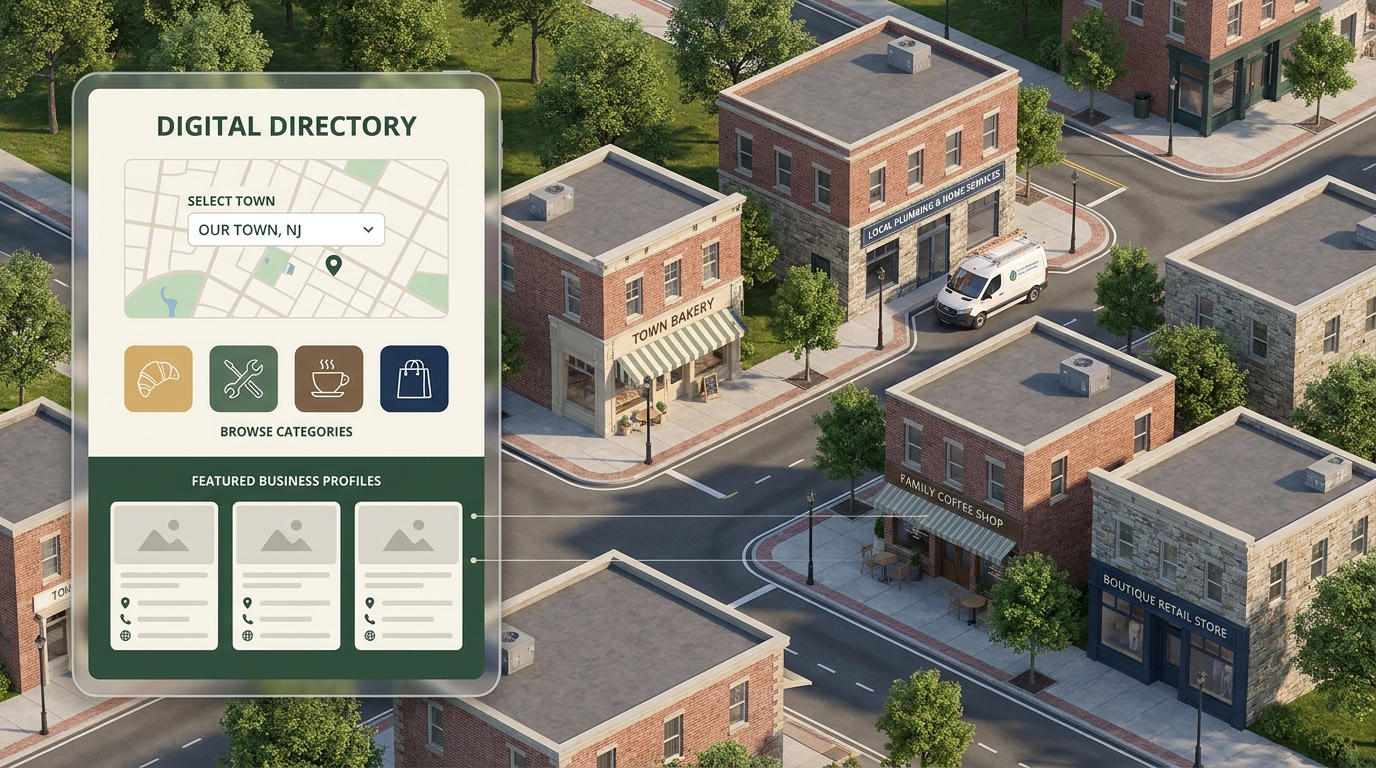
NJLocalInfo.com is built around specific New Jersey communities, including Summit, Westfield, Rahway, Union, and dozens of others across the state. Each listing connects your business directly to residents searching within that town, not to a general NJ audience or a national one. The platform also supports classified ad posting, which gives local sellers and service providers an additional channel to reach community members who are browsing locally.
Promoted listing options can increase your visibility when residents browse your town’s section. Beyond directory placement, the parent agency (AgencyServicesGRP.com) offers SEO services designed for local businesses, with the goal of helping them grow their organic search presence over time. That combination gives you both an immediate listing and a longer-term digital growth path, something most standard directories don’t offer.
Getting your listing details right from day one
A listing is only as strong as the information inside it. Use consistent NAP (name, address, and phone number) across every directory you appear on. Choose the most specific category available, write your service description for the town resident reading it rather than for search engines, and include a clear call to action. Tell people what to do next: call, request a quote, or visit the shop.
Neighborhood sponsorships that generate trackable leads
Sponsorship formats that fit a small business budget
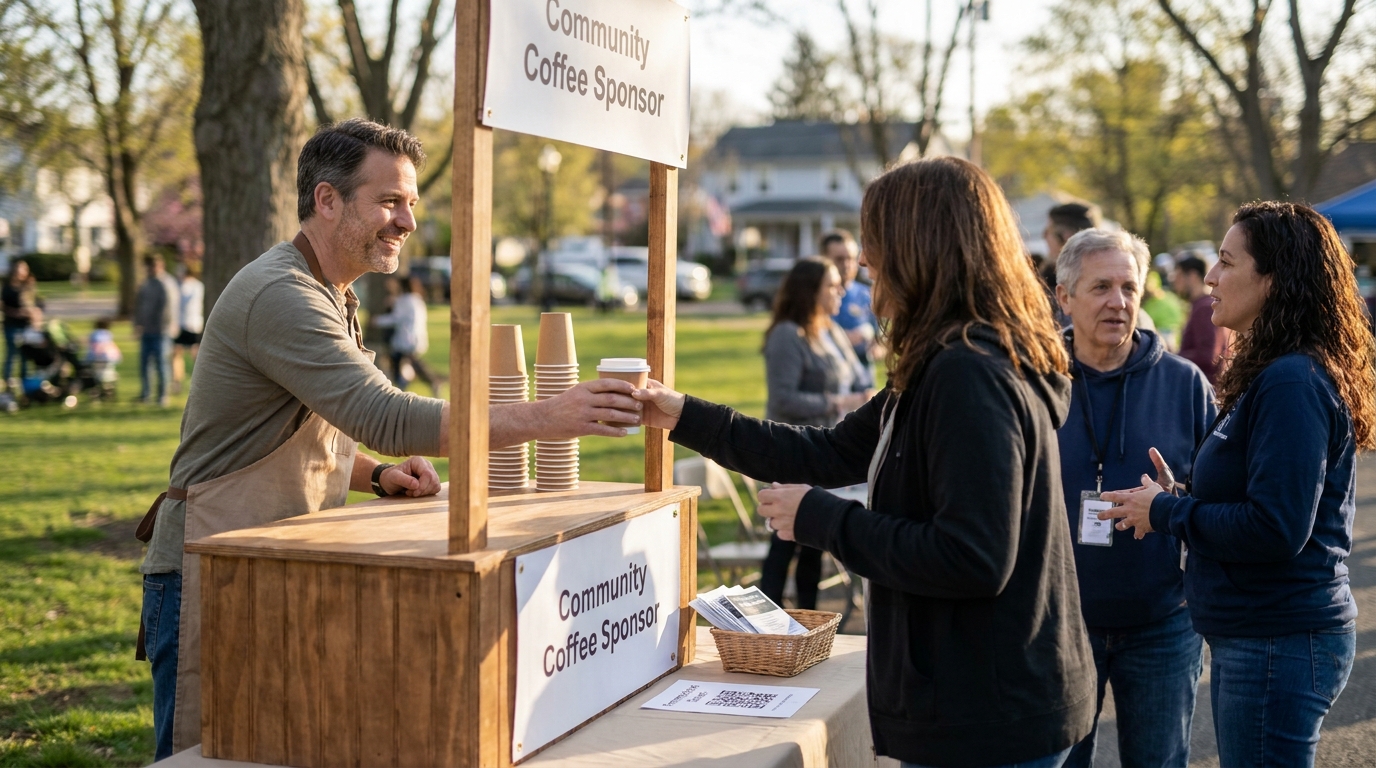
You don’t need to sponsor a stadium to generate local awareness. Youth sports teams, school outdoor projects, charity runs, and community festivals all offer sponsorship opportunities, many for under $500, and some for under $200. The key is choosing an event where your business has a natural connection to the audience attending. A landscaping company sponsoring a school outdoor project, for example, puts the brand in front of exactly the homeowners most likely to need residential landscaping services.
In-kind sponsorships, donating products or services instead of cash, can be especially effective for small businesses. A café donating coffee for a block event, or a print shop donating event programs for a school fundraiser, gets your name in front of the community without a cash outlay. Negotiate for signage, a social media mention, or a booth as part of the deal.
How to negotiate for more than a banner
Passive logo placement is hard to track and easy to ignore. Before you commit to any sponsorship, ask for a specific package of deliverables. A booth lets you have real conversations. An email mention in the event newsletter reaches people who weren’t even at the event. A verbal announcement puts your name in people’s ears in a trusted context. A first-visit offer distributed to attendees gives you a concrete way to track whether anyone showed up because of the sponsorship.
Every sponsorship should include at least two promotional assets from the organizer: one digital and one in-person. If the organizer won’t agree to that, the sponsorship isn’t structured for a measurable return.
Tracking ROI with a coupon code or QR link
The formula for sponsorship ROI is straightforward: take the incremental gross profit generated by the campaign, subtract the campaign cost, then divide by the campaign cost. To make that calculation possible, you need a way to identify which customers came from the sponsorship. A unique QR code or promo code tied to each event makes that connection clear. One code per sponsorship, tracked in a simple spreadsheet, gives you the data you need to decide whether to repeat or move on.
Hyperlocal content marketing for your specific town
What hyperlocal content looks like in practice
Generic content like “5 Tips for Hiring a Plumber” attracts readers from anywhere. Hyperlocal content like “What to Know About Water Line Permits in Westfield, NJ” attracts people who are ready to hire in that specific town right now. The audience is smaller, but the intent is much stronger. These visitors are further along in the buying process before they even click your link.
Effective formats include town-specific blog posts, neighborhood guides, local event recaps, and community spotlights. Each piece should reference real local details: street names, permit offices, neighborhood-specific regulations, or local landmarks. Those details signal geographic relevance in a way that generic content never can, and they build genuine trust with readers who recognize the specifics you’re describing.
Where to publish and how to get local distribution
Start with your own business website, where hyperlocal content builds its strongest long-term SEO value. Then publish on your social profiles for immediate community reach. Platforms like NJLocalInfo.com provide local citation value and put your content in front of residents already browsing town-specific listings. That multi-channel approach covers both search-based discovery and community-based browsing at the same time.
Combining directory placement with content for a compounding effect
A business listed on NJLocalInfo.com that also publishes hyperlocal content creates two separate discovery paths. A resident might find you through a town directory search, or they might find a blog post you wrote about their specific neighborhood and then click through to learn more. That local double-exposure approach means your name appears in more places without doubling your marketing budget. Each channel reinforces the other and compounds over time.
Building partnerships with local chambers and community groups
How to identify the right local partners
The right partner serves the same geographic area with a complementary, not competing, purpose. A gym partnering with a nutritionist, or a realtor partnering with a home-improvement contractor, lets both businesses reach the same type of customer without stepping on each other’s offerings. Chamber committees, local nonprofit boards, and neighborhood community groups are all solid starting points for identifying partners who share your audience. These community outreach strategies cost little to pursue and can open doors that paid advertising never reaches.
A simple outreach framework that gets responses
Generic outreach rarely gets a reply. Before you contact anyone, research their recent events, priorities, and leadership. Then lead with what you can contribute, not what you want. A sample email to a chamber contact might open with a specific initiative they’re running and offer one concrete way you can support it, followed by a single low-risk ask: a 20-minute conversation about a small pilot project.
When you do get that meeting, come prepared with a structured agenda. Work through these points in order:
- Clarify the shared purpose
- Identify each side’s needs
- Agree on what each party brings to the table
- Define the smallest useful first project
- Assign responsibilities and choose one measurement method
- Confirm the next step before the meeting ends
A clear agenda keeps the conversation productive and gives both parties something concrete to leave with.
What a small pilot partnership looks like in 30 days
A 30-day pilot might be a co-hosted event with a neighboring business or a cross-referral experiment where each business promotes the other to their existing customer base. Before you start, agree in writing on four things: the target audience, each party’s promotional role, the channel you’ll use to promote it, and one clear measurement method. A partnership with a local chamber of commerce often works the same way: start with one committee meeting or one co-sponsored event before committing to an annual membership package. These community engagement marketing efforts tend to build momentum gradually, and that’s exactly the point.
Measuring community business exposure: the four KPIs that matter
The four metrics every local business should track
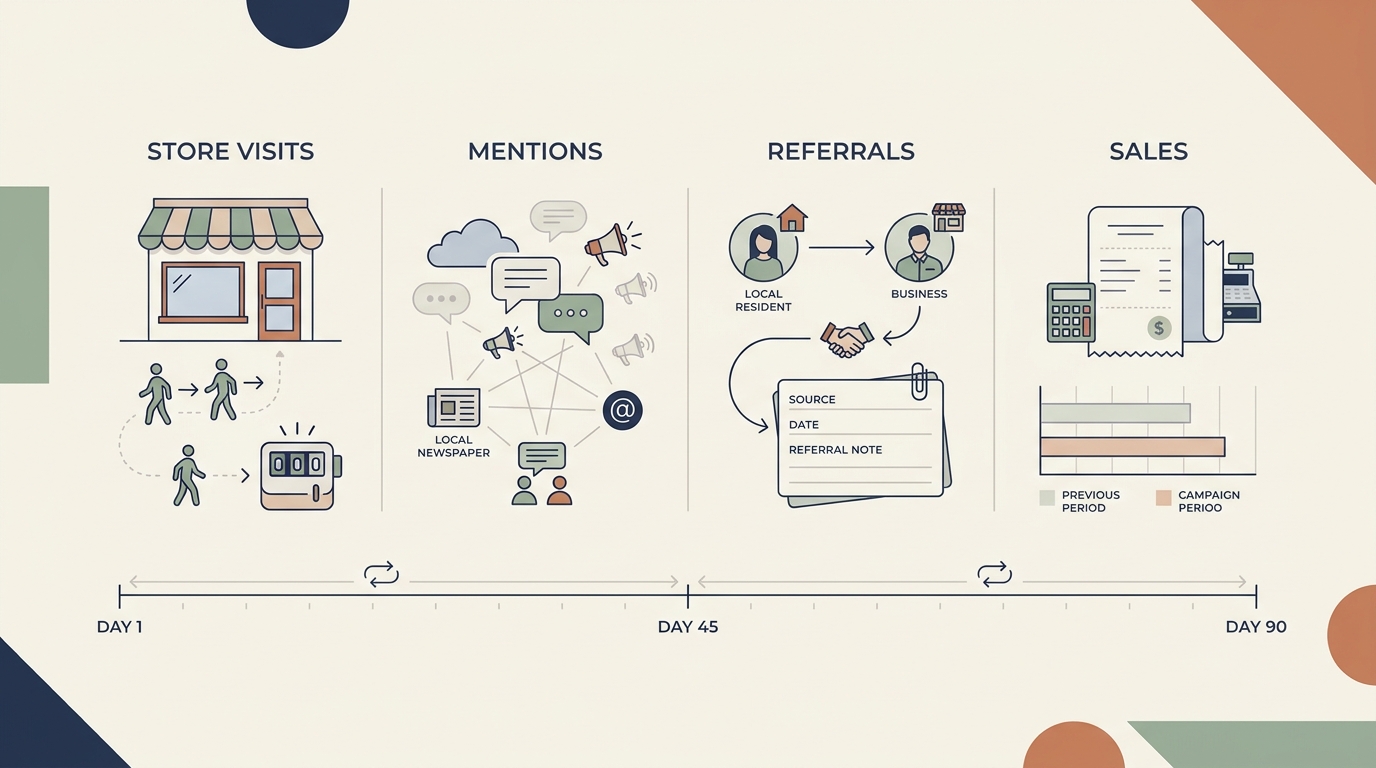
A simple four-area dashboard covers everything you need. Track foot traffic by counting store visits at consistent times and comparing campaign days with your normal baseline. Track social mentions by searching your business name and branded hashtag weekly and logging results in a spreadsheet. Track referral sources by asking every new customer “How did you hear about us?” and coding the answers. Track sales lift by comparing campaign-period revenue to the same period from the prior year.
For foot traffic, the formula is: campaign-period visits minus baseline visits, divided by baseline visits, multiplied by 100. For sales lift, the same structure applies with revenue in place of visits. These formulas are simple enough to run in a basic spreadsheet with four columns: date, activity, metric, and result.
Simple tracking tools that cost nothing
You don’t need software to start measuring. A clicker or tally sheet at the entrance handles foot traffic. Google Alerts tracks online mentions at no cost. Platform analytics on social channels show reach and engagement data. A unique QR code or promo code for each campaign separates one channel’s results from another. The “How did you hear about us?” question at checkout costs nothing and delivers direct referral data every single day.
Setting a 90-day community business exposure benchmark
Run one tactic from each of the three channels, directory listing, sponsorship, and hyperlocal content, for 90 days before evaluating results. As an illustrative target, a 10 to 15 percent increase in referral mentions and new-customer inquiries over your baseline would suggest your local marketing tactics are gaining traction, though actual benchmarks vary by category and business size. Give each channel enough time to compound before making changes. The biggest mistake is pulling back too early, before the local awareness has had time to build.
Ready to start with the highest-leverage tactic first?
If you’re a New Jersey business owner, one of the fastest moves you can make is getting your business listed on a hyperlocal directory. NJLocalInfo.com puts your business in front of town-specific residents who are already searching for local services, not a national audience that will never walk through your door. Claim or update your Google Business Profile first, then add NJLocalInfo.com to put your business directly in front of your town’s residents.
If you’re ready to go beyond a listing and grow your organic search presence across the broader web, the team at AgencyServicesGRP.com offers SEO services built for local businesses. A strong directory presence and a consistent SEO strategy work better together. Reach out to get started.
Frequently asked questions
What is community business exposure and why does it matter?
Community business exposure is the visibility a business has within its immediate geographic area, through directories, word of mouth, sponsorships, and local content. It matters because it produces far more relevant leads than broad digital advertising. A resident two blocks away who finds you through a town-specific listing is much more likely to become a customer than someone three states away who clicked a national ad.
How much does it cost to start with community-based marketing?
Many tactics can be tested for under $200, including a local directory listing, a QR-coded sponsorship activation, and one hyperlocal blog post. For in-person sponsorships and events, budget $200, $500 to give those efforts the best chance of producing measurable results. You don’t need an agency or a large budget to get started, you need a plan and one committed first step.
Does listing on NJLocalInfo.com help with local SEO?
Local directory listings build citations that support local SEO by helping search engines verify your business name, address, and phone number across the web. NJLocalInfo.com structures listings around specific NJ towns, which means your listing aligns with the exact geographic searches your customers are already making. That town-level relevance adds a layer of precision that national directories don’t provide.
How long before community exposure tactics produce results?
Many businesses begin to see early signals, increased referral mentions or new inquiries, within 30 to 60 days of starting. The compounding effect of directory placement combined with hyperlocal content typically takes closer to 90 days to show clearly. Run each tactic consistently for a full quarter before deciding what to keep, adjust, or cut.
Your next move starts this week
You don’t need a big marketing budget to win in your town. Start with a local directory listing that puts you in front of town-specific searchers. Add at least one neighborhood sponsorship with a trackable offer. Then build out hyperlocal content that demonstrates your expertise in your specific community. Each tactic reinforces the others and becomes more effective over time, that’s the compounding power of a real community business exposure strategy.
Pick the first tactic you can launch this week, not next month. For most NJ businesses, that means claiming a directory listing on NJLocalInfo.com alongside your Google Business Profile. It’s one of the fastest ways to create town-level visibility with the residents most likely to become your next customers. Start there, track the results, and build from a foundation that actually reaches the people in your zip code.
Know this business? Click here to leave a quick testimonial.
All businesses listed are independently operated. While we aim to provide accurate information, please verify each provider’s credentials, licensing, and insurance directly before hiring.
 |
Get The Biggest & Best Traffic For Your BusinessClick Here – Let Us Scale Your Organic Traffic with Our AI Busting SEO Service |
Listen to the podcast below for more details …
Visit our Agency Services Website (AgencyServicesGRP.com) for more details.
NJ Local Business Directory Listings By Town
Find local businesses and services serving your community throughout New Jersey. [Get Listed]
Advertise your local business in New Jersey here on our NJ Business Directory & Classifieds Ads section of NJLocalinfo.com. [Get The Benefits of Listing]
|
GetThe Biggest & Best Traffic For Your BusinessClick Here – Let Us Scale Your Organic Traffic With Our AI Busting SEO Service. |
Audio Message For Business Owners Below …
Visit our Agency Services Website (AgencyServicesGRP.com) for more details.