


Key Takeaways: Why Small Business Directory Listings Matter
- Accurate, consistent directory listings help customers and search engines confirm your business’s name, address, phone number, services, and local service area.
- A complete listing—with current hours, clear services, photos, contact information, and customer reviews—builds trust and makes it easier for ready-to-hire customers to contact you.
- National platforms are important, but they can produce visibility outside the areas you actually serve. For local service businesses, relevant local exposure matters more than broad, unfocused impressions.
- NJLocalInfo.com helps New Jersey businesses reach a more geographically relevant audience by organizing listings around the towns and communities they serve. That means a local contractor, landscaper, cleaner, or other service provider can be found by nearby residents who are more likely to become real leads.
- Use NJLocalInfo alongside your Google Business Profile and other trusted directories to strengthen your local presence, improve citation consistency, and create another path for nearby customers to find your business.
If your business isn't showing up when nearby customers search for what you offer, a small business directory listing is one of the most direct ways to fix that. You've claimed your Google Business Profile. You have a Yelp page. You've asked a few happy customers to leave reviews. And yet, when someone two towns over searches for exactly what you offer, your business doesn't show up. The problem isn't effort. It's visibility in the right places.
Getting listed in a local business directory is one of the most consistent, underused moves for closing that gap. Platforms like NJLocalInfo.com are built specifically for this problem: they organize businesses by New Jersey town so that residents searching for local services find actual local results, not a national marketplace full of irrelevant options. That's a different kind of visibility than Google or Yelp alone can provide.
This article covers what a small business directory listing does, what it delivers in practical terms, and how to make one work for your business, whether you're starting from scratch or trying to get more out of what you already have.
What a small business directory listing actually is
A small business directory listing is a structured profile of your business published on a directory platform. It contains your business name, address, phone number, hours, category, description, and often photos and reviews. It's not a website, and it's not a social media page. It's a dedicated entry in a curated index that both search engines and consumers use to find local businesses.
The distinction matters because a lot of business owners treat listings as an afterthought once the website is live. But directories operate independently of your website. Customers discover businesses through directory platforms all the time before ever visiting a company's site. For many service-area businesses, a well-optimized listing can drive as many direct calls as the website does, sometimes more.
The information inside a standard listing
Most directory listings ask for the same core data fields: your business name, address, and phone number (commonly called NAP), your primary category, a description of your services, hours of operation, a link to your website, and photos. These fields aren't just for customers browsing the directory. Search engines crawl and index this data as part of how they build an understanding of who your business is, where it operates, and what searches it should appear for, a process well documented in Google's own guidance on local search signals.
Every field you fill out completely adds to that picture. Every field you skip leaves a gap that a competitor's complete listing will fill instead. Industry research consistently shows that listing completeness correlates with stronger local visibility and higher click-through rates.
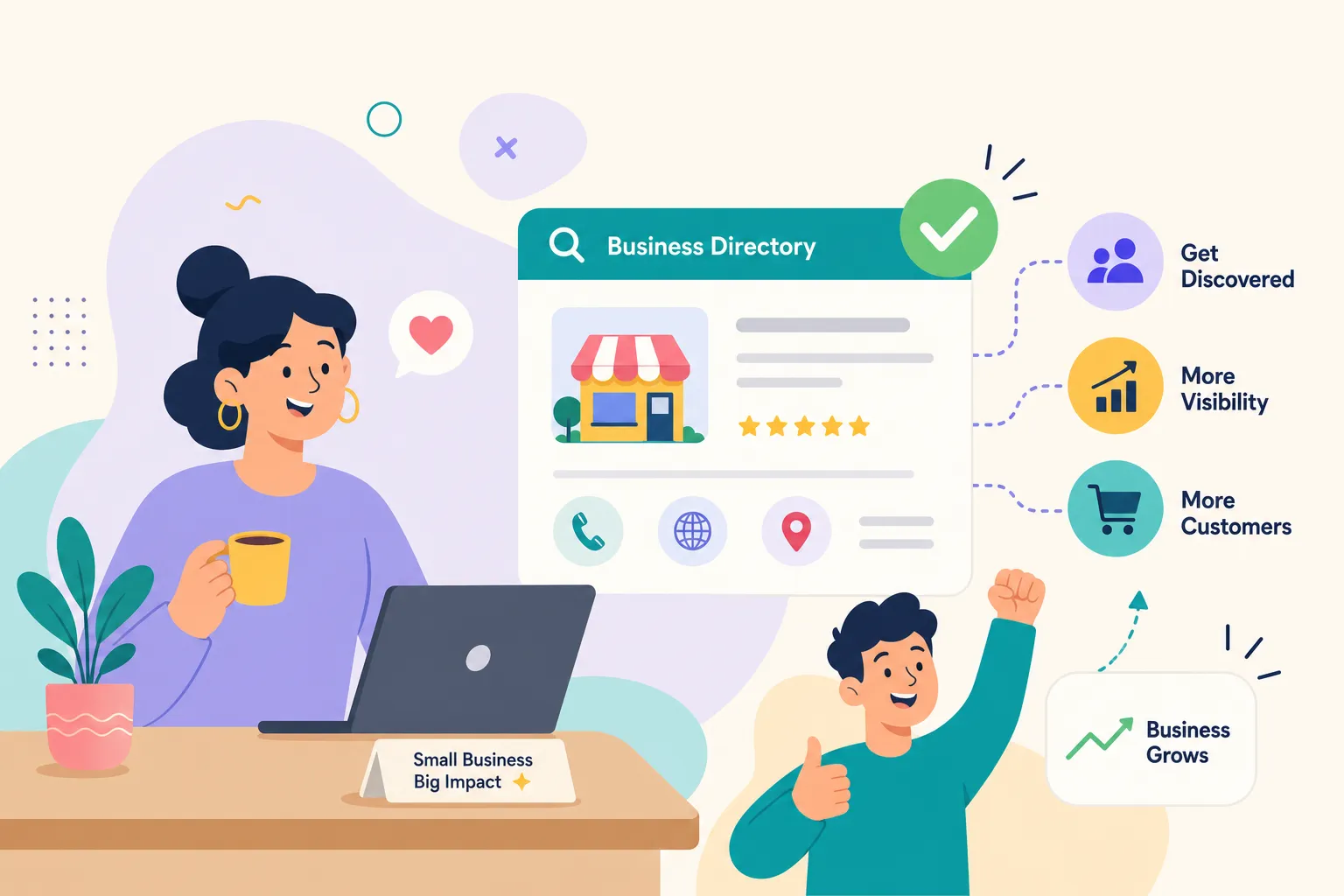
Benefits of a small business directory listing: local search visibility
When your business appears in multiple reputable directories with consistent information, search engines gain confidence that your business is real, established, and relevant to specific geographic searches. This is the core mechanic behind local citation building, and it's one of the reasons small business listings matter beyond the individual traffic each directory sends. Listing your business on authoritative business directory sites can be an important part of that strategy: authoritative business directory sites are often the most impactful places to start.
Local citations are mentions of your business across the web that include your NAP data. Think of a citation as a vote of confirmation: the more authoritative directories carry consistent information about your business, the stronger the signal Google receives about your legitimacy and local relevance. For example, a cleaning company listed consistently on Google Business Profile, Yelp, Bing Places, and a hyperlocal directory like NJLocalInfo.com sends a much clearer geographic signal than one present on only a single platform.
NAP consistency and why search engines care
If your business address appears differently across five directories, with different abbreviations, an outdated suite number, or an old phone number, search engines receive conflicting signals. That inconsistency makes it harder for Google to confirm which version of your business data is accurate, and it can suppress your visibility in local search results.
Consistent NAP data across authoritative business directory sites reinforces a single, trusted version of your business identity online. The rule is simple: your name, address, and phone number should be identical in substance across every listing, including your Google Business Profile, your website, and every directory where you're listed.
How citations translate to local rankings
Google's local algorithm weighs relevance, proximity, and prominence. Directory listings feed the prominence side of that equation by adding corroborating references to your business across the web. Citation consistency and volume from trustworthy sources, including Google Business Profile, Yelp, Apple Maps, Bing Places, and niche directories, compound over time and improve where you appear in local search results.
Citations alone won't override a strong competitor with better reviews and a more complete Google Business Profile. But they function as a foundation. A business with strong, consistent citations across reputable platforms gives search engines exactly the kind of structured confirmation they look for when deciding which local results to surface.
The tangible benefits a directory listing delivers
Search engine mechanics are useful to understand, but the real question for most small business owners is simpler: what do I actually get from this? The answer goes beyond rankings.
Visibility in front of high-intent customers
Customers who search directories are closer to a buying decision than someone scrolling through a social media feed. They're looking for a specific service, often right now, and they're comparing a short list of nearby providers. A listing on the right directory puts your business in front of that intent at exactly the right moment, not during awareness-building, but during active selection.
That context makes directory traffic genuinely valuable. Research on local search behavior shows that users searching for services in their immediate area frequently have near-term or immediate intent. Someone searching a local business directory for a plumber isn't usually doing research for next month. They need someone soon, and your listing is how they find you.
Trust signals that help convert browsers into callers
Reviews, photos, verified hours, and a complete business profile all function as trust signals. First impressions form fast online, usability research suggests visitors make quick judgments within seconds of landing on a page. A listing with accurate hours, real photos, and a clear description communicates that you're professional and active.
Businesses with incomplete or outdated listings lose potential customers to competitors whose listings look more reliable, even when the underlying service quality is identical. A missing phone number, an old address, or no photos can quietly cost you calls every week without you ever knowing it happened.
Why national directories often miss the mark for local businesses
National directories like Yelp, Angi, and Google Business Profile are worth using, and no one should skip them. But they come with a structural problem for locally focused businesses: they aggregate millions of listings and deliver traffic from a wide geographic area. For a plumber who serves three towns, most of that traffic is irrelevant.
The traffic mismatch problem
When a customer in another state finds your NJ-based cleaning service through a national directory, that's a wasted impression. National directories often rank broadly, which means the person seeing your listing may live nowhere near your service area. The result is low conversion rates and a poor return on the time you invest in maintaining the listing.
Geographic relevance is the most underrated factor in local advertising. More impressions don't help if the people seeing your listing aren't in a position to actually hire you.
Scale works against smaller operators on national platforms
On national platforms like Yelp or Angi, your business competes directly with every other business in your category across a broad metro area. A newer or smaller local business can easily get buried under competitors with hundreds of reviews and years of platform history. National directories are designed for consumer choice at scale, which means smaller, newer, or hyperlocal operators are structurally disadvantaged from the start.
That's not an argument against using national platforms. It's an argument for not relying on them exclusively when your business serves a specific community.
How town-level directories give locally focused businesses a real edge
A hyperlocal directory built around specific towns solves the traffic mismatch problem by design. The audience is already filtered by geography before they ever see your listing.
What town-by-town targeting actually means in practice
A town-level directory organizes listings by specific communities, not by broad metro region or state. When a resident in one of those towns searches for a local service, they're not browsing a national marketplace. They're looking at a directory built around their community. That's a fundamentally different quality of audience than a national platform delivers, and it's why locally focused businesses tend to see higher relevance from these listings.
The residents using a community-focused directory have already filtered by location themselves. They want someone nearby. Your listing is already relevant before they've read a single word of your description.
How a listing on a community-focused platform works differently
On a hyperlocal platform, your small business directory listing isn't competing with every similar business in the state. It's visible to the specific community you actually serve. A landscaper in Westfield shows up for residents in Westfield, not residents across the state who would never hire them regardless. The result is fewer total impressions but far more relevant ones, which drives better leads and better conversion on every contact.
For service businesses with a defined service area, that relevance difference translates directly into calls and booked jobs. NJLocalInfo.com is built on exactly this model, organizing New Jersey businesses by town so the right customers find you first.
What makes any directory listing actually work
No matter which directories you use, the quality of your listing determines the results. A half-complete profile on a strong platform will still underperform a fully optimized listing on a smaller one.
The elements every complete listing needs
Start with the basics done right: accurate and consistent NAP, a precise primary category, and a clear description that explains what you do and who you serve. Add current hours, high-quality photos, and a full list of your services or service areas. Each element contributes to both search engine confidence and customer trust. Skipping any of them leaves your listing measurably weaker than it needs to be.
When writing your description, avoid keyword stuffing. Write for the customer first and let the relevant terms appear naturally. A description that reads well to a human will also read well to a search engine.
Keeping your listing accurate over time
A listing that was accurate at launch but now shows an old phone number or wrong hours actively hurts your business. Customers who show up during hours you're actually closed don't call back. Customers who can't reach you on a disconnected number don't try a second time. Audit your listings at least once a quarter and update hours immediately whenever they change, a cadence recommended by local SEO practitioners across the industry.
Review management matters just as much. Responding to customer reviews, including negative ones, shows prospective customers that you're engaged and accountable. Directories tend to reward active profiles with better visibility, and it's a well-documented pattern in customer behavior that a thoughtful response to a negative review can actually improve trust more than the negative review itself damages it.
Start with the right listings and keep them sharp
When your small business directory listing is complete, consistent, and placed on the right platforms, it does real work: putting structured information in front of high-intent customers at the moment they're actively searching. It reinforces citation authority across the web, supporting your local search rankings over time. And when the directory matches your actual service area, the audience it delivers is already filtered and relevant before they ever click on your name.
National directories belong in your strategy, but they shouldn't be the whole strategy. For businesses serving a specific New Jersey town or community, a listing on a hyperlocal platform like NJLocalInfo.com closes the gap between visibility and relevance that national platforms can't fully address on their own.
If you serve a specific NJ community and want your business in front of the people who actually live there, get listed on NJLocalInfo.com and put your business where local customers are already looking.
Know this business? Click here to leave a quick testimonial.
All businesses listed are independently operated. While we aim to provide accurate information, please verify each provider’s credentials, licensing, and insurance directly before hiring.
 |
Get The Biggest & Best Traffic For Your BusinessClick Here – Let Us Scale Your Organic Traffic with Our AI Busting SEO Service |
Listen to the podcast below for more details …
Visit our Agency Services Website (AgencyServicesGRP.com) for more details.
NJ Local Business Directory Listings By Town
Find local businesses and services serving your community throughout New Jersey. [Get Listed]
Advertise your local business in New Jersey here on our NJ Business Directory & Classifieds Ads section of NJLocalinfo.com. [Get The Benefits of Listing]
|
GetThe Biggest & Best Traffic For Your BusinessClick Here – Let Us Scale Your Organic Traffic With Our AI Busting SEO Service. |
Audio Message For Business Owners Below …
Visit our Agency Services Website (AgencyServicesGRP.com) for more details.

