

Key takeaways
- A fully optimized local business listing can drive up to 156% more “near me” traffic compared to businesses relying on their website alone (based on vendor-reported case study data).
- Hyperlocal directories connect you with high-intent buyers in your specific town, not a broad national audience.
- NAP consistency (name, address, phone) across all directories directly impacts how Google ranks your business locally.
- Claimed and optimized profiles generate 1.5 to 3 times more calls and website clicks than unclaimed ones.
- Tracking ROI from directory listings requires UTM-tagged links, call tracking, and a simple lead-source field in your CRM.
- Hyperlocal platforms like NJLocalInfo.com offer town-by-town targeting that tends to be more precise for NJ neighborhood-level searches than broader national directories.
Picture this: it’s 8 p.m. on a Tuesday in Summit, New Jersey. A homeowner spots a pipe leaking under the kitchen sink. She grabs her phone and searches “best plumber near me.” The businesses that appear in the next 30 seconds aren’t necessarily the most skilled plumbers in town. They’re the ones that showed up in the right places, with the right information, at exactly the right moment.
If you’ve ever wondered how a local business directory can help you get more customers in your town, that scenario is your answer. A well-placed, well-optimized listing puts your business in front of residents who are actively searching for what you offer, in your specific town, ready to act. This guide covers how directory listings build visibility and trust, why hyperlocal targeting outperforms broad national platforms, how to optimize every field that matters, and how to measure whether your listing is actually generating customers. Platforms like NJLocalInfo.com are built to make this kind of town-level discovery possible for New Jersey businesses that want to reach the right neighbors, not just a generic regional audience.
Before you read further, here’s what this article will help you accomplish:
1. How can a local business directory help me get more customers in my town?
A standalone website is a passive asset. It waits for people to find it. A local business listing, by contrast, places your business inside platforms that buyers are already using when they’re ready to spend money. That’s a fundamental difference in how customers discover you.
How local search intent works in small towns
Residents searching for a service in Westfield or Rahway are not browsing casually. They have a specific need, they’re close to a decision, and they want someone nearby. Directories carry strong geographic signals that help search engines connect those buyers to your listing. According to one 50-business case study of directory-listed vs. non-listed businesses, directory-listed businesses appeared in the Google local 3-pack at an 88% rate, compared to only 24% of non-listed businesses. That gap is even more pronounced in smaller, lower-competition towns where a complete, consistent profile stands out quickly.
The 24-hour window matters here too. A Google Consumer Insights study found that 76% of mobile “near me” searches result in a store visit within 24 hours. Buyers move fast. Your listing needs to be visible before they make that decision.

The role of local citations in Google’s ranking logic
Google doesn’t take your word for it when it comes to your business’s legitimacy. It cross-references your business name, address, and phone number across multiple trusted sources. When those details match consistently, Google gains confidence that your business is real, active, and locally relevant. That confidence translates directly into better placement in town-level search results. Local SEO practitioners widely cite a target of 30 to 50 accurate, high-quality citations as a solid starting point for small-town businesses, with first-page local results averaging closer to 75 to 85 citations across all markets.
2. How a directory listing builds trust before a customer ever calls
Getting found is only the first step. Once a potential customer lands on your listing, the profile itself either closes the gap between curiosity and contact, or it doesn’t. Many customers check a business’s directory profile before picking up the phone, and what they see in those 30 seconds shapes their decision.
Reviews as the new word-of-mouth for local businesses
In a small New Jersey town, reputation spreads through neighborhoods. Online reviews on directory platforms work the same way: they tell a neighbor “this business delivered.” A high-performing review profile includes a consistent volume of recent reviews (not just a burst from three years ago), a mix of detailed and brief testimonials, and, critically, owner responses. Responding to reviews signals that you’re engaged and accountable. That alone sets you apart from competitors who never respond to feedback, good or bad.
Why a complete profile signals credibility
Completeness is not optional. A profile with missing hours, no photos, and a vague description quietly signals to potential customers that the business might be closed, disorganized, or simply not worth their time. A strong profile includes accurate hours (updated before holidays), at least 10 real photos showing your team and work, a clear service description, credentials listed, and specific service areas defined. Claimed and actively maintained profiles generate 1.5 to 3 times more calls and website clicks than unclaimed ones. The work you put into a listing directly reflects in the actions customers take.
3. The hyperlocal advantage: why your specific town is the differentiator
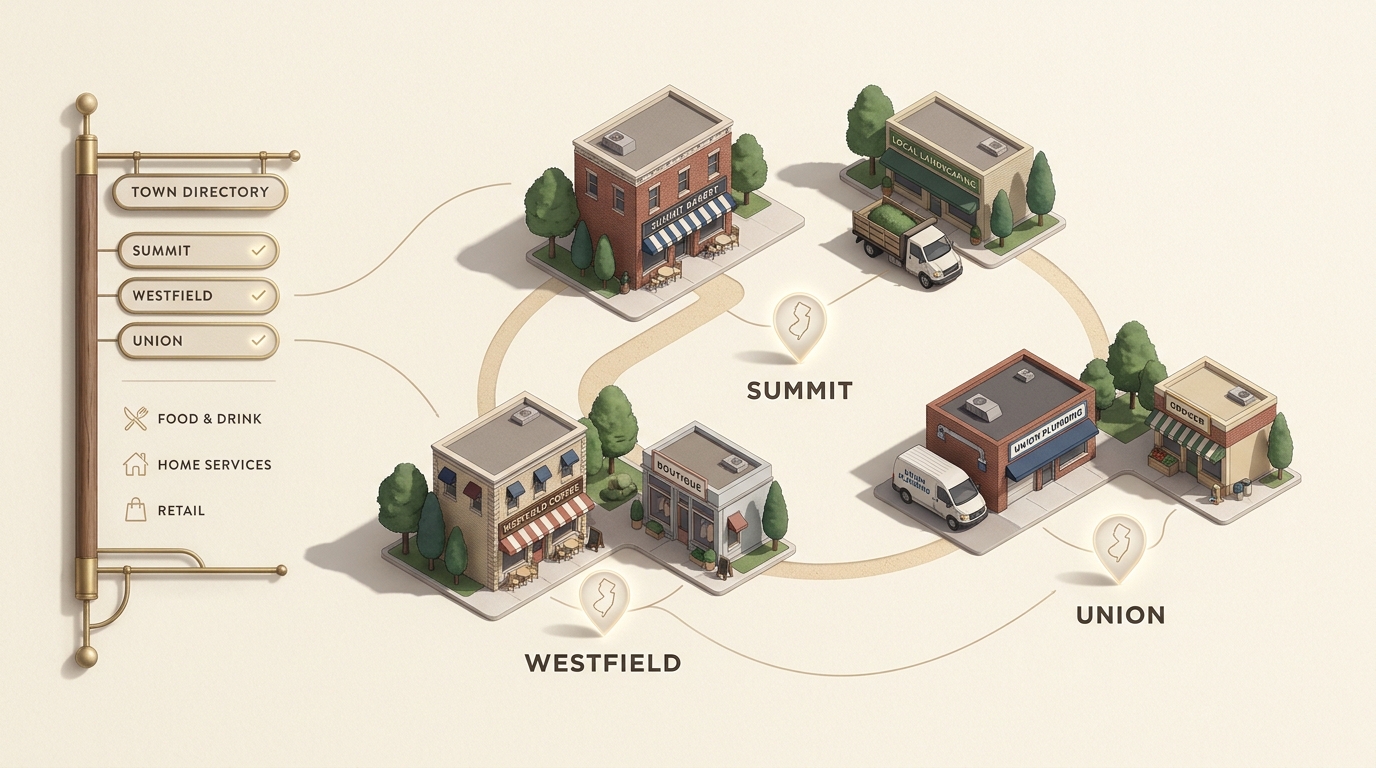
National directories like Yelp and Angi organize results across wide regions, sorted by algorithm and ad spend. A plumber in Union, NJ, competing for visibility against every plumber in Essex, Middlesex, and Hudson Counties faces a steep climb. Hyperlocal directories solve this problem by organizing listings town by town, so the audience already lives nearby and is ready to buy local.
How directory listings win customers in your town, and why hyperlocal beats broad platforms
Broad platforms optimize for broad audiences. That works well when a user is comparison-shopping across a region, but it’s a poor fit when a Westfield resident wants to hire someone local who knows the area, and they want to hire this week. Hyperlocal directories prioritize proximity from the start. A resident searching for a service in their town sees businesses from that town first, not a ranked list of competitors from across the state. For small businesses without the budget to outbid national chains on advertising, that kind of targeted placement changes everything.
Why NJLocalInfo.com is built for this kind of visibility
NJLocalInfo.com operates exactly the way small NJ businesses need: town-by-town listings across Union County and surrounding communities, connecting residents with businesses in their specific neighborhoods. A landscaper in Summit doesn’t need visibility in Bergen County. They need visibility in Summit and the surrounding blocks where their potential customers actually live. NJLocalInfo.com is designed to deliver that targeted reach without the noise of a national platform. For businesses looking to expand further, the affiliated agency also offers SEO services aimed at helping local listings grow into broader organic search visibility over time.
4. How to optimize your listing so browsers become paying customers
Claiming a listing is the entry point. Optimizing it is what separates a listed business from a found one. Many businesses claim their profiles but leave important fields incomplete. The ones that win fill every meaningful field with specific, accurate information.
The listing fields that move the needle most
Start with your business name, using the real-world name exactly as customers know it. No keyword stuffing, no location tags added artificially. Select the most specific primary category available, not a broad one. Write a description that explains who you serve, what you do, your service area, and what makes you different. Use a structure like this: “[Business name] provides [primary service] for [customer type] in [city/area]. We specialize in [specific services] and are known for [credible differentiator].” Upload at least 10 real photos showing your team, work, and location. Keep hours current, and if you serve customers at their location, define your service area clearly so the platform knows where to show you.
NAP consistency and why it can’t slip
Your name, address, and phone number must match exactly across every directory you’re listed on. Not approximately. Exactly. The same abbreviations, the same suite format, the same phone number, the same spelling. Even small inconsistencies create conflicting signals that suppress local rankings. Build a master NAP record before you claim or create any new listings, and use it as your reference every time. Check for outdated phone numbers, old addresses, and duplicate listings at least once a quarter.
A simple approach to collecting more reviews
Don’t overthink review generation. Ask customers in person after a positive interaction, then follow up with a text or email that includes a direct link to your listing. Respond to reviews promptly, ideally within a few days of receiving them, whether positive or negative. No incentives, no fake reviews. Just a consistent, genuine ask built into your normal workflow. Over time, this compounds into a review profile that quietly closes sales before you ever answer the phone.
5. How to measure what your directory listing is actually doing
Visibility is not the goal. Customers are. Without tracking, you can’t tell whether your listing investment is working or simply producing impressions that go nowhere. Three tools answer the questions that matter most, and together they give you a clear picture of which directories are actually earning their keep.
The three tracking tools every small business should use
Create a unique UTM-tagged URL for each directory and point it to Google Analytics. This tells you exactly how much traffic each listing sends to your website. Assign a unique call tracking number to every major directory listing, all forwarding to your normal business line. This tells you which directories generate phone calls and how many turn into qualified leads. Use Google Business Profile Insights to monitor calls, direction requests, and website clicks directly from your GBP profile. Each tool answers a different question, and together they give you a complete picture of where your customers are actually coming from.
A simple ROI calculation for local directory listings
Use this formula: attributed gross profit minus directory cost, divided by directory cost, multiplied by 100. A $300-per-year listing that produces $1,200 in gross profit delivers a 300% ROI. Factor in your time for setup and maintenance, not just the listing fee. Review results on a 60 to 90-day window, though timelines can vary depending on your category and local competition level, especially if your sales cycle is longer than a week. Drop listings that don’t produce qualified leads. Reinvest in the platforms that do.

Ready to see how a local business directory can help you get more customers in your town?
Local business directories help small businesses get found by the right people, in the right town, at the right moment. Being listed matters. Being listed well matters more. A complete, accurate, review-rich profile in the right directory compounds over time, producing more visibility, more trust, and more customers without requiring a big ad budget.
For New Jersey business owners, the smartest first step is getting listed where your neighbors are actually looking. NJLocalInfo.com organizes listings town by town across Union County and surrounding communities, so residents in Westfield, Summit, Rahway, Union, and beyond can find you when they’re ready to buy. That town-level focus gives you a level of targeting precision that broader platforms aren’t built to deliver.
Get your business listed on NJLocalInfo.com to build your hyperlocal presence and connect with nearby residents searching for exactly what you offer. If you’re ready to go further and grow your broader organic search rankings, reach out to the affiliated agency team to explore SEO services built for the NJ market.
Frequently asked questions
How long does it take for a directory listing to bring in new customers?
For businesses in low-competition small towns, optimized listings can appear in local search results within two to four weeks. Most meaningful traffic increases tend to show up in the first 60 to 90 days, especially when the listing is fully completed with photos, reviews, and accurate service information, though results vary based on your category, local competition, and how consistently you maintain the profile.
Do I need to be on Yelp if I’m already on Google Business Profile?
Not necessarily. Google Business Profile is the highest priority for local search visibility. Add Yelp only if your industry and local market actively use it. Restaurants, salons, and personal-service businesses tend to see the most value from Yelp. For many other categories, your time is better spent completing your GBP profile and building local citations on relevant community directories.
What is NAP consistency and why does it matter?
NAP stands for name, address, and phone. When these match exactly across every directory, Google treats your business as verified and locally credible. Inconsistencies create conflicting signals that can suppress your ranking in local results, cause duplicate listings, and send customers to wrong phone numbers or old addresses. Build a master NAP record and use it as the standard for every listing you create or claim.
Is a hyperlocal directory better than a national one for a small NJ town?
For reaching residents in a specific town, hyperlocal directories often provide more precise targeting than national platforms. National directories show results across broad regions, which means your listing competes with businesses from across the state. Hyperlocal directories like NJLocalInfo.com are organized around specific communities, which tends to produce higher-intent visitors who are already nearby and ready to hire. That said, major platforms also offer local filters and map features, so the strongest approach combines a solid hyperlocal presence with a fully completed Google Business Profile for maximum coverage.
Know this business? Click here to leave a quick testimonial.
All businesses listed are independently operated. While we aim to provide accurate information, please verify each provider’s credentials, licensing, and insurance directly before hiring.
 |
Get The Biggest & Best Traffic For Your BusinessClick Here – Let Us Scale Your Organic Traffic with Our AI Busting SEO Service |
Listen to the podcast below for more details …
Visit our Agency Services Website (AgencyServicesGRP.com) for more details.
NJ Local Business Directory Listings By Town
Find local businesses and services serving your community throughout New Jersey. [Get Listed]
Advertise your local business in New Jersey here on our NJ Business Directory & Classifieds Ads section of NJLocalinfo.com. [Get The Benefits of Listing]
|
GetThe Biggest & Best Traffic For Your BusinessClick Here – Let Us Scale Your Organic Traffic With Our AI Busting SEO Service. |
Audio Message For Business Owners Below …
Visit our Agency Services Website (AgencyServicesGRP.com) for more details.