

Key Takeaways
- AI search has cut organic click-through rates by as much as 61% for informational queries
- Traditional SEO signals like Google Business Profile, local citations, and backlinks still drive the majority of local leads
- New AI signals including schema markup, E-E-A-T, and structured content now determine who gets cited in AI-generated answers
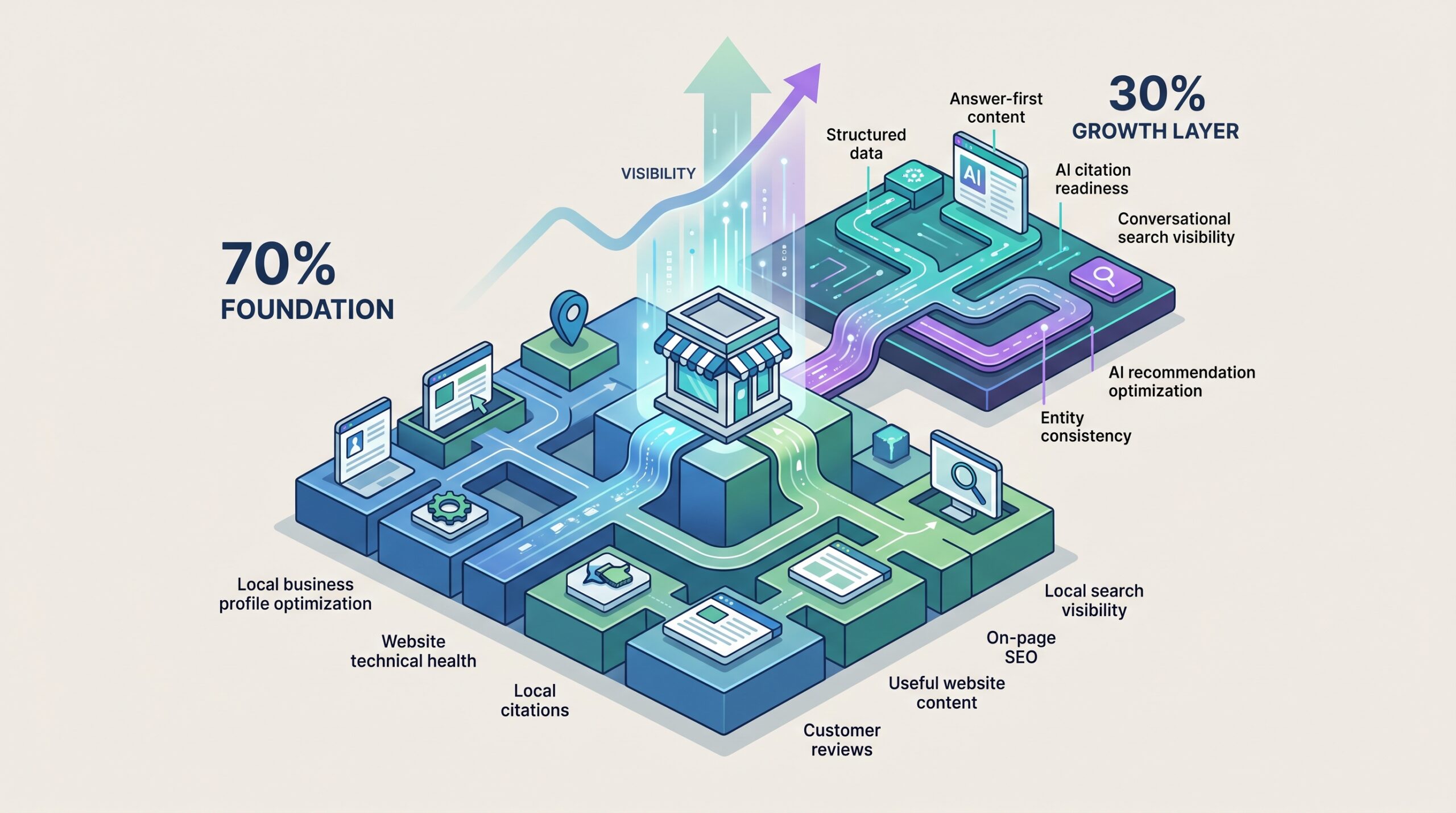
- NJ businesses should split their SEO budget roughly 70% traditional tactics, 30% AI-specific optimizations
- A prioritized 7-step checklist gives you a concrete starting point, steps 1 through 4 focus on foundation, steps 5 through 7 on content and tracking
- Managing both traditional and AI SEO layers through one integrated strategy is more efficient than running two separate playbooks
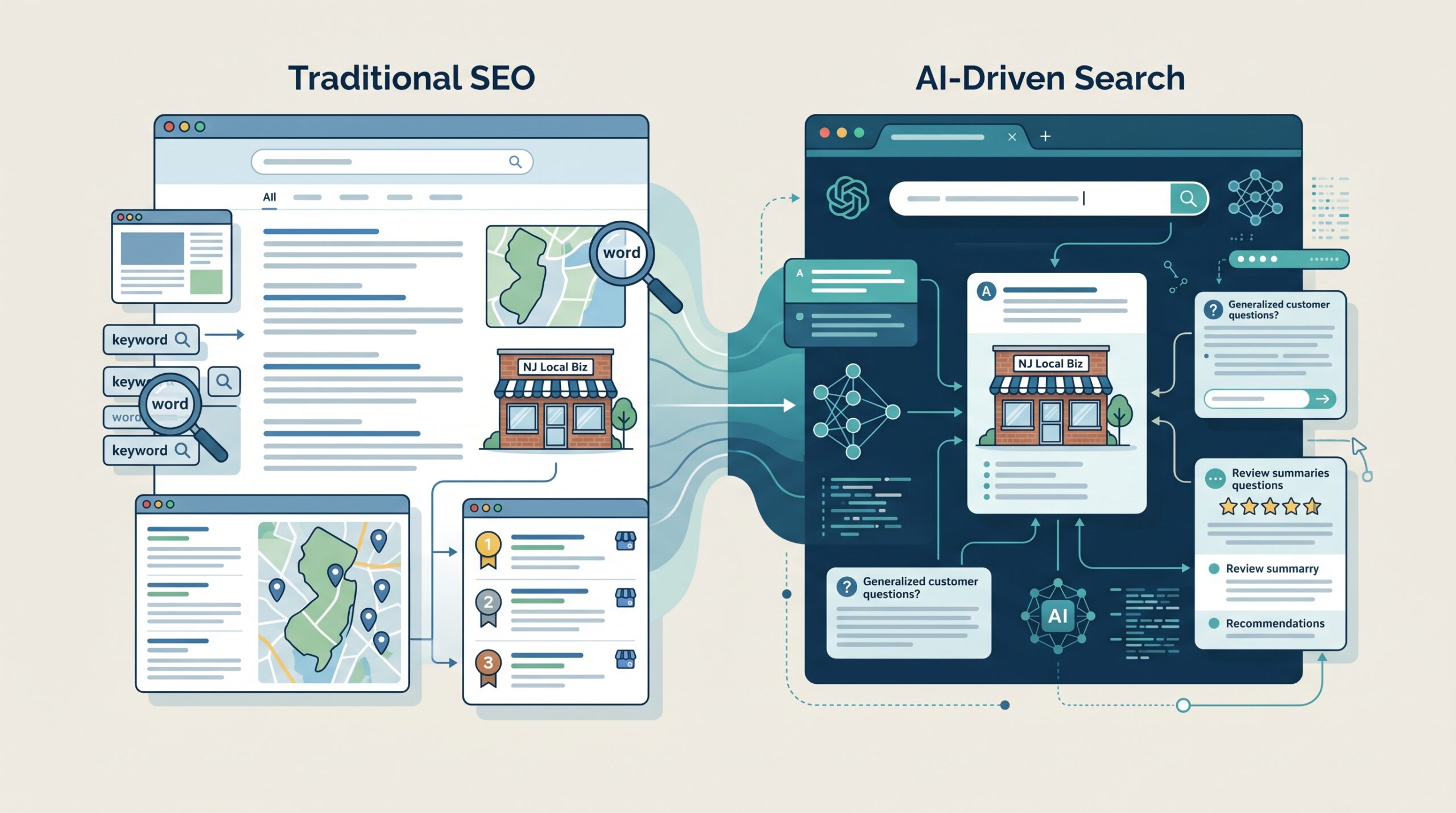
Picture this: you're a plumber in Summit, NJ. Your Google rankings look fine. You show up on page one. But your phone calls have dropped and website traffic is down significantly since last year. Nothing is broken. The problem is that search itself changed around you. Understanding AI SEO vs. traditional SEO, and what NJ businesses need to know to adapt, is exactly what this article covers.
Google AI Overviews now sit at the very top of results, delivering answers without requiring a click. AI chatbots like ChatGPT and Gemini frequently answer questions without directing users to any website, and research suggests they drive roughly 95% less referral traffic than traditional Google search. For NJ business owners who built their visibility on traditional SEO, this shift feels invisible at first and painful later.
By the time you finish reading, you'll know which traditional tactics to keep, which AI-era signals to add, and you'll have a concrete 7-step action plan built for the NJ market. Resources like NJLocalInfo.com exist specifically to help New Jersey businesses navigate these changes at the hyperlocal level, and we'll show you exactly how to use them.
How AI Search Changed the Rules for Local Businesses
What Google AI Overviews Actually Do to Your Traffic
AI Overviews now occupy the top of Google's search results page, synthesizing answers directly on the page before a user ever sees a traditional blue link. According to research from Seer Interactive and similar analyses, organic click-through rates drop between 34% and 61% when an AI Overview is present. For purely informational searches, that decline can reach as high as 89%.
The zero-click trend amplifies this further. SparkToro and Datos research projects that roughly 70% of searches will end without a click to any website. Google confirmed in early 2026 that AI Overviews now appear on approximately half of all U.S. searches. That's the competitive environment NJ businesses operate in right now.
AI SEO vs. Traditional SEO: How the Shift Hits NJ Businesses Harder Than Most
Local service businesses depend heavily on informational queries: “best electrician in Westfield NJ,” “how much does a bathroom remodel cost in Union County.” These are precisely the query types AI Overviews dominate most aggressively. The channels NJ customers use to find local help are shifting fast, and businesses that relied exclusively on traditional ranking signals are feeling that pressure most acutely.
The good news: this isn't a death sentence for local SEO. It's a signal change. Businesses that adapt earn citations inside AI answers instead of just rankings below them, and citations translate directly into traffic and calls.
What Traditional SEO Still Does Well in 2026
Google Business Profile, Citations, and Reviews Aren't Going Anywhere
Local SEO signals still drive the majority of leads for NJ service businesses. Google Business Profile (GBP) optimization, consistent NAP data (Name, Address, Phone), and steady review accumulation remain the highest-ROI tactics at the local level. GBP and citation fixes typically show initial movement within 60 to 90 days, making them among the fastest-return investments available.
Reviews now feed AI visibility too. According to a 2025 Whitespark Local Search Ranking Factors survey, reviews rank as the second most important signal for AI citation visibility, with 91% of respondents identifying them as a key factor. Every new review you earn serves double duty: it strengthens traditional rankings and improves your chances of appearing in AI-generated answers simultaneously.
Backlinks and On-Page Fundamentals Still Build the Foundation
AI engines don't read link graphs directly, but they pull answers from pages that already rank. Backlinks get your content into the pool AI draws from. Without ranking authority, you won't get cited. On-page fundamentals, clear service descriptions, mobile-friendly design, and fast load times, remain the technical prerequisite for everything else.
Traditional SEO is your foundation, and the goal is to build on top of it rather than replace it. Think of AI-era optimizations as a second floor: you can't add them without the structural work underneath already in place.
AI SEO vs. Traditional SEO: New Signals You Can't Ignore
Schema Markup and Structured Data: The Highest-ROI Addition Right Now
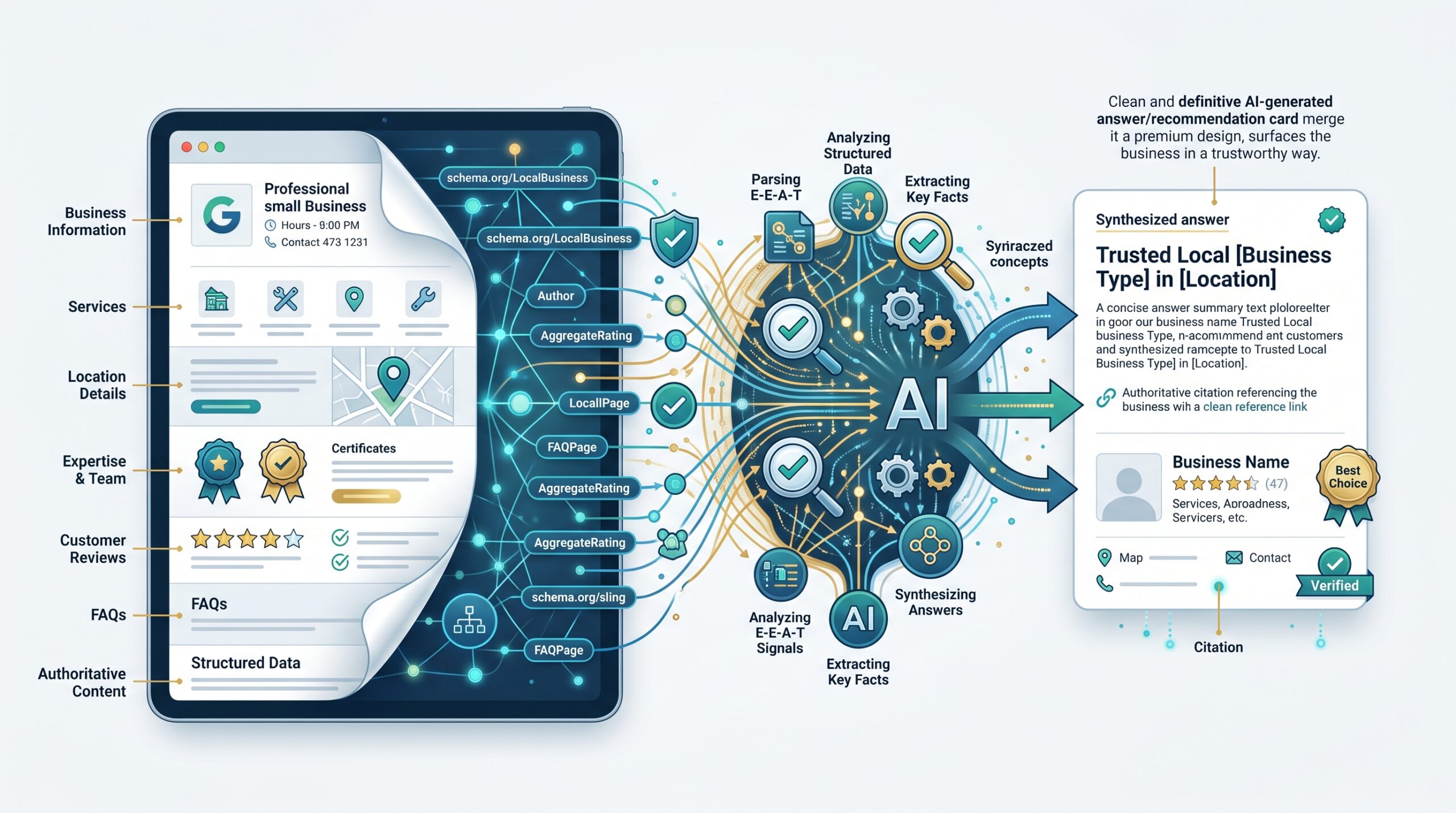
Schema markup is the single highest-impact addition for NJ businesses targeting AI visibility. Research from SE Ranking and similar studies shows FAQPage schema increases appearance in Google AI Overviews by approximately 3.2 times compared to unstructured content. For NJ businesses, LocalBusiness schema with complete service-area data, listing specific towns rather than just a county, is the local-specific version that matters most.
Schema is code added to your website that tells AI engines exactly who you are, what you do, and what questions you answer. Your web developer or SEO agency handles the implementation. The key schema types for local service businesses are LocalBusiness, FAQPage, and AggregateRating. Together, they give AI systems pre-parsed data they can cite with confidence.
Answer-First Content and E-E-A-T: What Gets You Cited
E-E-A-T stands for Experience, Expertise, Authoritativeness, and Trust. AI engines prefer to cite sources they recognize as credible, and content needs to demonstrate real expertise through specific examples, data, and local case studies rather than generic filler. Pages with three or more distinct data points see meaningfully higher citation rates in AI-generated answers than thin, generalized pages.
The content types that earn AI citations most consistently are FAQ pages, step-by-step guides, comparison articles, and original local data. Publishing NJ-specific content like a “2026 Union County Home Renovation Cost Guide” positions your business as the authoritative local source AI engines want to reference. National platforms can't replicate that kind of hyperlocal credibility, which is a genuine competitive advantage for locally rooted NJ businesses.
A 7-Step Action Checklist for NJ Business Owners
Steps 1, 4: The Foundation You Need First
- Fix NAP consistency across every directory, social profile, and listing. Inconsistent business name, address, or phone number undermines both traditional rankings and AI entity recognition. Start here before anything else.
- Fully optimize your Google Business Profile. Fill out every field, add current photos, respond to every review, and use the Q&A section to answer the questions your customers ask most often. An incomplete GBP is leaving free visibility on the table.
- Add hyperlocal NJ directory citations. Platforms like NJLocalInfo.com list businesses by specific NJ towns, giving you the town-level citation signals that generic national directories miss entirely. These local citations strengthen both traditional rankings and AI brand recognition, and they connect you directly with nearby residents actively searching for local services.
- Implement LocalBusiness and FAQPage schema. Work with a developer or SEO agency to add structured data that tells AI systems exactly what your business does and which towns it serves.
Steps 5, 7: The Content and Tracking Layer
- Publish answer-first content targeting real questions NJ customers ask. Format it with clear headers, numbered steps, and specific local data points. Generic content won't earn citations; locally specific, structured content will.
- Earn at least 3 to 5 local NJ backlinks from credible sources: chambers of commerce, local news sites, industry associations, or community organizations. These links build the ranking authority that puts your content into AI's extraction pool.
- Track AI visibility, not just keyword rankings. Standard rank-tracking tools don't capture whether your business appears in ChatGPT, Gemini, or Google AI Overviews. Test queries directly in those platforms, and make sure any agency you hire includes AI citation data in their monthly reporting.
How to Split Your SEO Budget Between Old and New Tactics
The 70/30 Split That Works for Most NJ Businesses
Put 70% to 80% of your SEO budget on traditional local tactics: GBP optimization, citations, location pages, and review generation. Allocate the remaining 20% to 30% to AI-specific work including schema implementation, answer-first content, and visibility monitoring. Which steps you handle in-house versus outsource will affect where those dollars go, foundation steps like NAP consistency and GBP optimization are manageable internally, while schema implementation and ongoing content production typically benefit from professional support.
NJ is a high-competition, densely suburban market, and traditional local SEO still drives the majority of leads for service-based businesses. The AI layer amplifies that foundation rather than replacing it. For budget anchoring: a single-location NJ business in a moderate-competition market needs roughly $800 to $1,500 per month to run standard local SEO effectively. High-competition areas like Newark, Jersey City, or Bergen County typically require $1,500 to $3,000 per month to compete. Budgets under $500 per month rarely deliver meaningful results and can introduce shortcuts that cost more to reverse later.
When It Makes Sense to Bring in Professional Help
Managing traditional SEO and AI SEO simultaneously requires different skill sets, tracking tools, and consistent time investment. Many NJ business owners find it more practical to consolidate both layers under one agency rather than managing them separately, it reduces coordination overhead and keeps strategy cohesive.
When evaluating agencies, prioritize transparency in reporting (including AI citation tracking), a methodology that explicitly addresses both traditional and AI signals, and demonstrated experience in the NJ local market. An agency that treats these as two separate engagements will cost more and deliver less consistency than one running an integrated dual-layer strategy from the start.
Why an Integrated SEO Approach Makes Sense for NJ Businesses Right Now
What a Dual-Layer SEO Strategy Actually Means
An integrated SEO strategy, one built to maintain visibility even as AI summaries and zero-click results reduce traditional click-through rates, combines foundational local signals (GBP, citations, backlinks) with AI-era signals (schema, E-E-A-T, answer-first content) into a single coherent approach. The goal is to rank in traditional results and earn citations in AI-generated answers at the same time.
NJ's competitive suburban market means businesses can't afford to let either layer erode. Managing them as one unified strategy is more efficient and more effective than treating them as separate initiatives. That's the practical case for this dual-layer methodology in 2026.
What to Expect from a Methodology Built for 2026
An AI-era SEO engagement starts with a technical audit covering schema implementation and crawlability. It builds a content plan around answer-first local topics, runs citation building through both national directories and hyperlocal NJ platforms, and delivers monthly reporting that covers traditional rankings alongside AI visibility metrics.
NJLocalInfo.com's hyperlocal directory ecosystem covers town-level citation signals that broader platforms miss, and businesses that pair that directory presence with a structured content and schema strategy gain visibility across both traditional and AI-driven results. That combination addresses what most standard SEO engagements leave out entirely.
Ready to Stop Guessing and Start Showing Up Where NJ Customers Are Looking?
Whether you're starting with a basic directory listing or need a full integrated SEO strategy, NJLocalInfo.com offers an NJ-focused platform built for both traditional and AI search visibility.
- Get listed on NJLocalInfo.com to start building hyperlocal, town-level citations today.
- Schedule a strategy call with AgencyServicesGRP.com to map out a 2026 SEO plan built for AI search and the NJ market specifically.
Conclusion
The rules of search didn't disappear. They expanded. Understanding AI SEO vs. traditional SEO, and what NJ businesses need to know to act on that difference, is the foundation of staying visible in 2026. Traditional SEO still drives local leads, and AI SEO now determines who gets cited in generative answers. NJ business owners don't need to choose between the two; they need a strategy that handles both, built for the specific dynamics of the New Jersey market.
Businesses that adapt their visibility strategy now won't just protect their current traffic. They'll be positioned to capture the traffic their competitors lose as AI search continues growing. AI SEO vs. traditional SEO is no longer a debate for NJ businesses, it's a both/and strategy, and the window to build that foundation before your competitors do is still open.
Frequently Asked Questions
Is traditional SEO still worth investing in for a New Jersey small business in 2026?
Yes, absolutely. Google Business Profile optimization, local citations, and review building still drive the majority of local leads for NJ service businesses. These tactics show initial results in 60 to 90 days, making them the fastest-return investments in local SEO. They also feed directly into AI visibility, since AI systems prefer to cite pages that already carry strong traditional ranking signals.
What is AI SEO and does my NJ business actually need it?
AI SEO is an approach designed to maintain local search visibility as AI-generated answers reduce traditional click-through rates. It layers schema markup, answer-first content, and entity authority on top of traditional SEO fundamentals. Most NJ businesses competing in 2026 benefit from this integrated approach, particularly those in high-competition markets like Union County, Newark, or Bergen County where both ranking and citation visibility matter.
How do I know if my business is appearing in AI-generated answers?
Standard rank-tracking tools don't capture AI visibility. Test your business directly by running relevant queries in ChatGPT, Gemini, and Google with AI Overviews enabled, and check whether your business gets cited. Use incognito mode to remove personalization effects, and run each query several times to account for variability. A qualified SEO agency should include AI visibility tracking alongside traditional rankings in their monthly reporting, if they don't, ask for it explicitly.
Know this business? Click here to leave a quick testimonial.
All businesses listed are independently operated. While we aim to provide accurate information, please verify each provider’s credentials, licensing, and insurance directly before hiring.
 |
Get The Biggest & Best Traffic For Your BusinessClick Here – Let Us Scale Your Organic Traffic with Our AI Busting SEO Service |
Listen to the podcast below for more details …
Visit our Agency Services Website (AgencyServicesGRP.com) for more details.
NJ Local Business Directory Listings By Town
Find local businesses and services serving your community throughout New Jersey. [Get Listed]
Advertise your local business in New Jersey here on our NJ Business Directory & Classifieds Ads section of NJLocalinfo.com. [Get The Benefits of Listing]
|
GetThe Biggest & Best Traffic For Your BusinessClick Here – Let Us Scale Your Organic Traffic With Our AI Busting SEO Service. |
Audio Message For Business Owners Below …
Visit our Agency Services Website (AgencyServicesGRP.com) for more details.

